

nonabsdid is an R package for visualizing and comparing
heterogeneity-robust staggered DID event-study estimates under
non-absorbing binary treatment, where
treatment status may switch on and off over time, including treatment
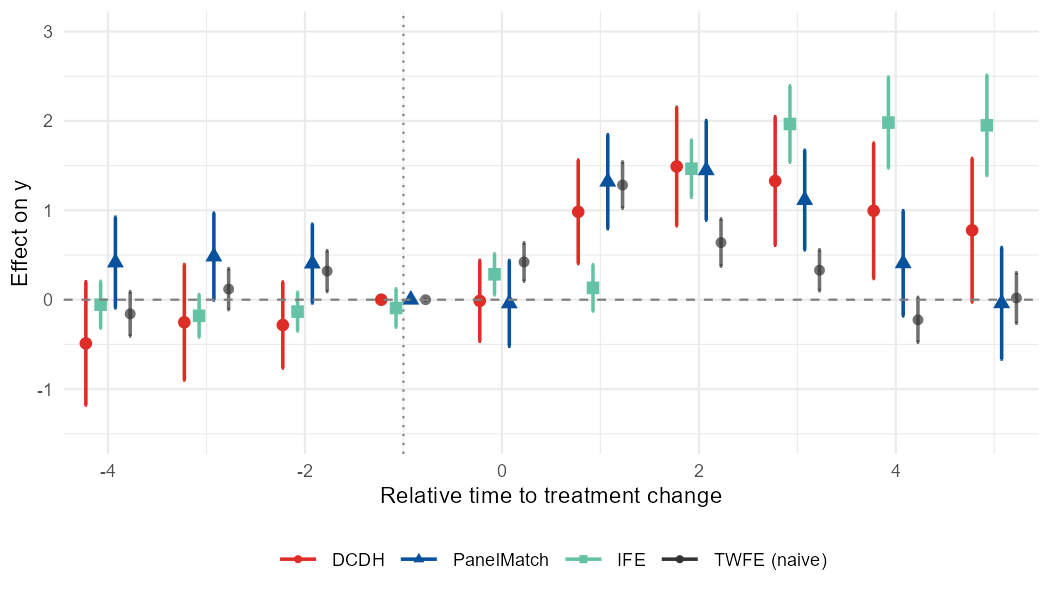
reversals. Its example output event-study plot is as follows.
This package can also produce a cohort-by-time “effect matrix” output as a heatmap so that you can read an estimator’s heterogeneity. It supports DCDH and fect (IFE/MC/FE).

This package covers existing multiple estimators below and runs
analysis via their own packages, then puts their output on the same time
axis, the same tidy schema, and the same ggplot2 panel so
you can compare them at a glance.
DIDmultiplegtDYN.PanelMatch.fect:
IFE (interactive fixed effects)FE (two-way fixed-effects imputation)MC (matrix completion)Note: The DCDH estimator depends on
DIDmultiplegtDYN, which in turn requirespolars.polarsis not on CRAN, so install it from R-multiverse:Sys.setenv(NOT_CRAN = "true") install.packages("polars", repos = c("https://community.r-multiverse.org", "https://cloud.r-project.org"))
Plus an optional naive TWFE reference series (via
fixest) drawn in a neutral color so you can see what the
heterogeneity-robust estimators are correcting against.
[!NOTE] When the version on CRAN is outdated, install from GitHub or R-universe for the latest version.
# Development version from GitHub:
# install.packages("pak")
pak::pak("takuma1102/nonabsdid")
You can install this package through r-universe.
install.packages(
  "nonabsdid",
  repos = c("https://takuma1102.r-universe.dev", getOption("repos"))
)
The estimator packages themselves (DIDmultiplegtDYN,
PanelMatch, fect, fixest) are
listed in Suggests, so install the ones you plan to
use.
At the early stage of an analysis, use
nabs_event_study_simple() to get an initial sense of how
the event-study estimates look. By default it runs a deliberately cheap
pass — DCDH plus two-way-FE imputation (c("DCDH", "FE"))
and a naive TWFE reference — and on large panels it works on a random
sample of units so the first look stays fast. The result is a single
overlay plot to inspect before moving on to estimator-specific
tuning.
library(nonabsdid)

res <- nabs_event_study_simple(
  mydata,
  outcome   = "y",
  treatment = "d",
  unit      = "id",
  time      = "t"
)

res$plot       # the figure
res$tidy       # combined tidy tibble across methods
res$per_method # per-method tidy tibbles
res$fits       # native estimator objects (only kept with keep_fits = TRUE)
Add the heavier estimators once the cheap pass looks reasonable — they are opt-in because PanelMatch’s bootstrap and IFE/MC’s cross-validation are slow on large panels:
res <- nabs_event_study_simple(
  mydata, outcome = "y", treatment = "d", unit = "id", time = "t",
  methods = c("DCDH", "PanelMatch", "IFE", "FE", "MC"),
  full = TRUE        # use every unit, not just the first-pass sample
)
If a particular estimator’s package is not installed, that estimator is skipped with a message, and the remaining methods still produce output.
For publication-ready work, switch to the full wrapper or to the underlying packages directly. The unified wrapper:
res_dcdh <- nabs_event_study(mydata,
                             outcome = "y", treatment = "d",
                             unit = "id", time = "t",
                             method = "DCDH",
                             lags = 6, leads = 8,
                             controls = c("x1", "x2"))

res_pm   <- nabs_event_study(mydata, ..., method = "PanelMatch")
res_ife  <- nabs_event_study(mydata, ..., method = "IFE")
res_fe   <- nabs_event_study(mydata, ..., method = "FE")
res_mc   <- nabs_event_study(mydata, ..., method = "MC")
Or call estimators directly and tidy their output:
fit <- DIDmultiplegtDYN::did_multiplegt_dyn(
  df = mydata, outcome = "y", group = "id", time = "t",
  treatment = "d", effects = 9, placebo = 6
)
tidy_dcdh <- as_nabs_event_study(fit, outcome = "y")

# Naive TWFE reference for the plot:
ref <- naive_twfe(mydata, outcome = "y", treatment = "d",
                  unit = "id", time = "t",
                  lags = 6, leads = 8)

# Overlay everything:
nabs_event_plot(
  res_dcdh$tidy, res_pm$tidy, res_ife$tidy,
  reference = ref,
  xlim = c(-6, 8), ylim = c(-2, 2),
  ylab = "Effect on outcome"
)nabs_event_plot() offers two ways to encode the pre/post
distinction, plus an option to join point estimates with a thin line.
Both arguments also flow through nabs_event_study_simple()
via ....
By default (style = "prepost_color"), each method gets
its own color with separate shades for pre- and post-treatment
periods:
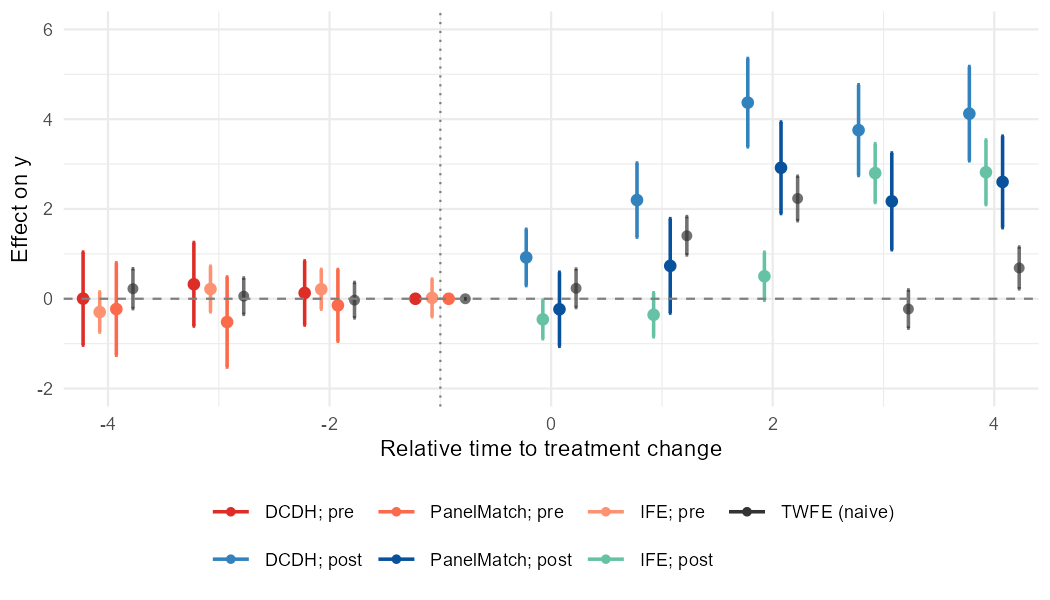
nabs_event_plot(res_dcdh$tidy, res_pm$tidy, res_ife$tidy, reference = ref)With style = "method_shape", color encodes the
method only, and the pre/post distinction is carried by the
marker shape (hollow circles for pre, filled triangles for post). This
reads cleanly in grayscale:
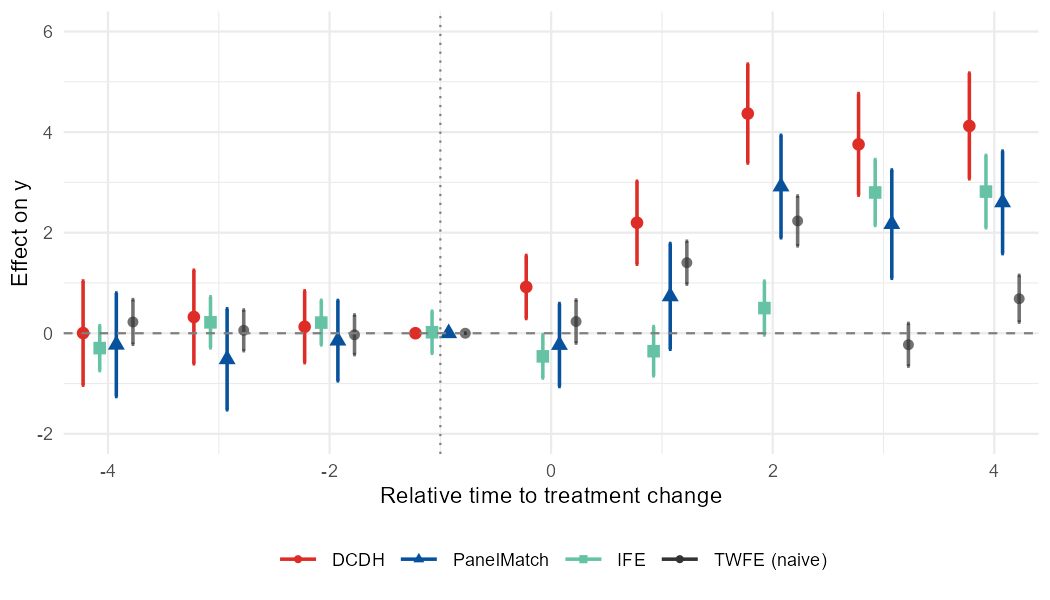
nabs_event_plot(res_dcdh$tidy, res_pm$tidy, res_ife$tidy, reference = ref,
                style = "method_shape")
Set connect = TRUE (works with either style) to join
each series’ point estimates with a thin line, drawn through the full
path (pre and post are connected, including across the treatment
boundary):
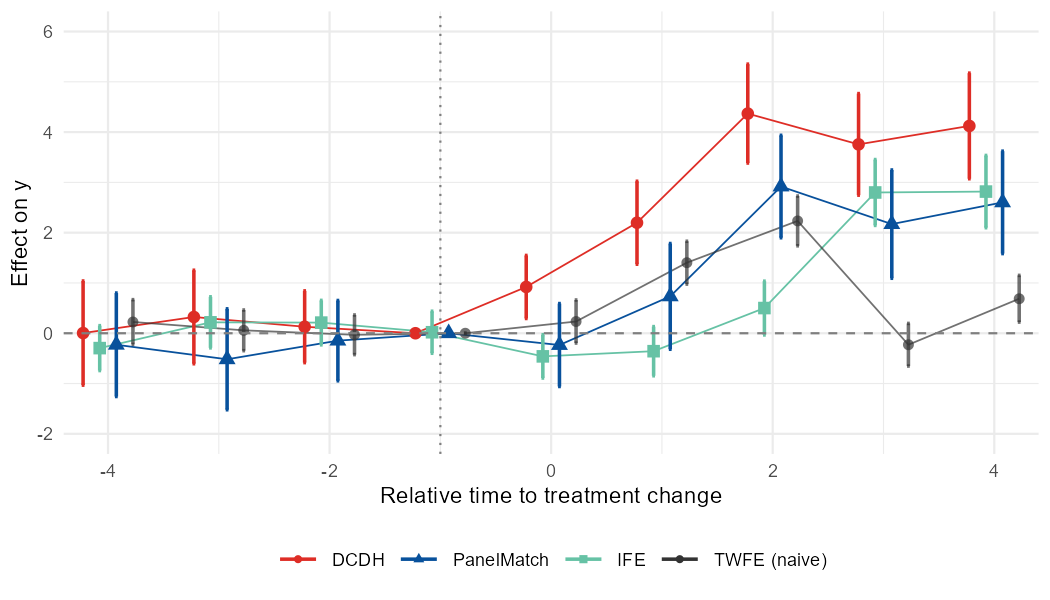
nabs_event_plot(res_dcdh$tidy, res_pm$tidy, res_ife$tidy, reference = ref,
style = "method_shape", connect = TRUE)If you have already run supported estimators, you can convert their
result objects into the common nabs_event_study_tbl schema
with as_nabs_event_study().
tidy_one <- as_nabs_event_study(fit_dcdh, outcome = "y")

tidy_all <- as_nabs_event_study(
  list(fit_dcdh, fit_panelmatch, fit_ife),
  outcome = "y"
)
Results returned by nabs_event_study() and
nabs_event_study_simple() can also be passed back to
as_nabs_event_study():
res <- nabs_event_study(...)
tidy_res <- as_nabs_event_study(res)

res_simple <- nabs_event_study_simple(...)
tidy_simple <- as_nabs_event_study(res_simple)All tidiers return a tibble of class
nabs_event_study_tbl with these columns:
| column | type | description |
|---|---|---|
time |
int | Relative period (0 = treatment onset/switch). |
estimate |
num | Point estimate. |
std.error |
num | Standard error (may be NA). |
conf.low |
num | Lower CI bound. |
conf.high |
num | Upper CI bound. |
window |
chr | "pre" if time < 0, else
"post". |
method |
chr | "DCDH", "PanelMatch", "IFE",
"FE", "MC", "TWFE", … |
outcome |
chr | Outcome variable name. |
All methods share this convention (time = 0 = treatment onset / the
period of a treatment switch, time = -1 = reference). DCDH’s native
output anchors the reference at 0, so it is shifted by one
period internally to line up.
Anything coercible to a data frame with at least time
and estimate columns also flows through
as_nabs_event_study(). Adding a new estimator later means
writing a one-line method that pulls the right slots — the plotting code
keeps working.
A few things are worth knowing before you point this at a big panel:
polars. The
DIDmultiplegtDYN backend refers to the polars
package; nonabsdid attaches it for you (with a one-time note), but it
must be installed. If automatic loading fails, run
library(polars) once and retry.unit or
cluster is replaced by integer codes (added as a new
column). This only relabels ids and never changes estimates.fect runs single-threaded by default.
For IFE/FE/MC,
parallel = FALSE is the default: on large panels, copying
the data to parallel workers tends to exhaust memory rather than help.
Set parallel = TRUE (optionally with cores)
for small panels.nabs_event_study() accepts cv,
nboots, r, parallel, and
cores for the fect family, and
number.iterations for PanelMatch’s bootstrap. For the
lightest IFE run, for example, fix the factors and skip cross-validation
with
nabs_event_study(..., method = "IFE", cv = FALSE, r = 2, parallel = FALSE).fect, and PanelMatch drop missing rows differently, so a
row with NA in a control may be used by one method and not
another; nonabsdid notes when partial missingness is present.nonabsdid ships Stata interoperability:
# Read a .dta directly (labelled columns and .a-.z missings handled),
# or just pass the path straight to the wrappers:
mydata <- nabs_read_dta("mypanel.dta")
res    <- nabs_event_study_simple("mypanel.dta",
                                  outcome = "y", treatment = "d",
                                  unit = "id", time = "t")

# Stata-style argument names from did_multiplegt_dyn are accepted and
# translated with a message (group -> unit, effects -> leads, placebo -> lags):
res <- nabs_event_study(mydata, outcome = "y", treatment = "d", time = "t",
                        method = "DCDH",
                        group = "id", effects = 8, placebo = 6)

# Write the tidy estimates back out for a Stata-using coauthor:
nabs_write_dta(res$tidy, "event_study_results.dta")
See vignette("nonabsdid-for-stata-users") for the full
option-by-option mapping from did_multiplegt_dyn and the
round trip back to twoway.
The event-study workflow above collapses every cohort onto one
relative-time axis. A separate feature line keeps the onset
cohort as a second dimension and draws it as a heatmap — rows
are cohorts, columns are relative (or calendar) time, fill is the
estimated effect. One method per plot reads best (the method becomes the
title); show_se = TRUE prints the standard error beneath
each estimate.


res_ife  <- nabs_effect_cells(panel, outcome = "y", treatment = "d",
                              unit = "id", time = "t", method = "IFE")
res_dcdh <- nabs_effect_cells(panel, outcome = "y", treatment = "d",
                              unit = "id", time = "t", method = "DCDH")

# individual heatmaps (recommended): auto-titled, estimates + SEs in each cell
plot_effect_matrix(res_ife$cells,  show_estimates = TRUE, show_se = TRUE)
plot_effect_matrix(res_dcdh$cells, show_estimates = TRUE, show_se = TRUE)

# passing several methods facets them with a shared scale, but gets crowded:
# plot_effect_matrix(res_dcdh$cells, res_ife$cells)
This currently supports DCDH and the fect family only. PanelMatch is intentionally omitted: a faithful cohort matrix needs per-cohort estimates and per-cohort SEs, and for PanelMatch that requires re-aggregating matched-set effects by switch time and re-running the matched-set bootstrap on that re-aggregation — out of scope for now, so it is left out rather than shipped with incorrect standard errors. Compare methods as triangulation of the pattern, not as cell-by-cell equality (the estimators differ in estimand, controls, and coverage). See the Cohort-by-time effect matrices and heatmaps article for more details.
This package is experimental. The output schema is intended to be stable, but the upstream estimator packages occasionally rearrange their internal structures, so please pin versions in production code.
If you use nonabsdid in your work, please kindly cite
the package:
Takuma Iwasaki (2026). nonabsdid: Heterogeneity-Robust DID Event Studies with Non-Absorbing Binary Treatments. R package version X.Y.Z. https://github.com/takuma1102/nonabsdid
Please also cite whichever underlying estimator(s) you actually used.